Davis Theft Lawyer
Theft Attorney in Davis, CA
The consequences of a theft conviction can be lifelong and devastating, even beyond incarceration and fines. A criminal record, especially a felony, can severely limit one’s ability to find work and housing, take out loans, and access public services. Such stakes may feel daunting, but you don’t have to face them alone. If you or a loved one is fighting theft charges in Davis, California, an experienced Davis theft lawyer like Conor Bell can help.

Defending Northern California Clients Against Theft Accusations
The Law Office of Conor Bell provides robust legal representation to clients accused of crimes in Northern California. As a former district-level criminal prosecutor, Mr. Bell uses his deep knowledge of prosecutorial strategy to strengthen his defense of his clients. He can also help you understand common criminal charges in Northern California and how they might impact your future. He is a member of California Attorneys for Criminal Justice, the state’s largest network of skilled defense professionals, and regularly represents Davis clients in the Yolo County Superior Courthouse.
Understanding California Theft Laws
In the California Penal Code, theft, or larceny, involves taking someone else’s property with the intent to deprive the owner of its use. It encompasses fraud, embezzlement, and theft of labor (wage theft) as well as more direct and concrete acts of stealing.
There are two major categories of theft crimes. The more severe charge is grand theft (aka grand larceny), while the lesser is petty theft (petit larceny). Both grand and petty theft are “wobbler” offenses, which means prosecutors can choose to charge them as either felonies or misdemeanors based on the circumstances of each case. Those with a criminal record should also learn how long you have to wait to get an expungement in California to clear their history.
A defendant’s criminal history may be used to elevate petty theft to a felony. Section 666 of the California Penal Code states that a petty theft can be charged as a felony if the defendant has prior convictions for both a violent or serious felony offense and a theft offense for which they were incarcerated.
Section 666.1 of the Penal Code, added by Proposition 36 in 2024, allows a defendant with two prior petty theft convictions to be charged with a felony upon a third petty theft offense. The Prison Policy Initiative reports that this and other penal code changes from Prop 36 will increase the number of people in California’s prisons by around 35% by 2029.
Penalties for Theft Crimes in Davis, California
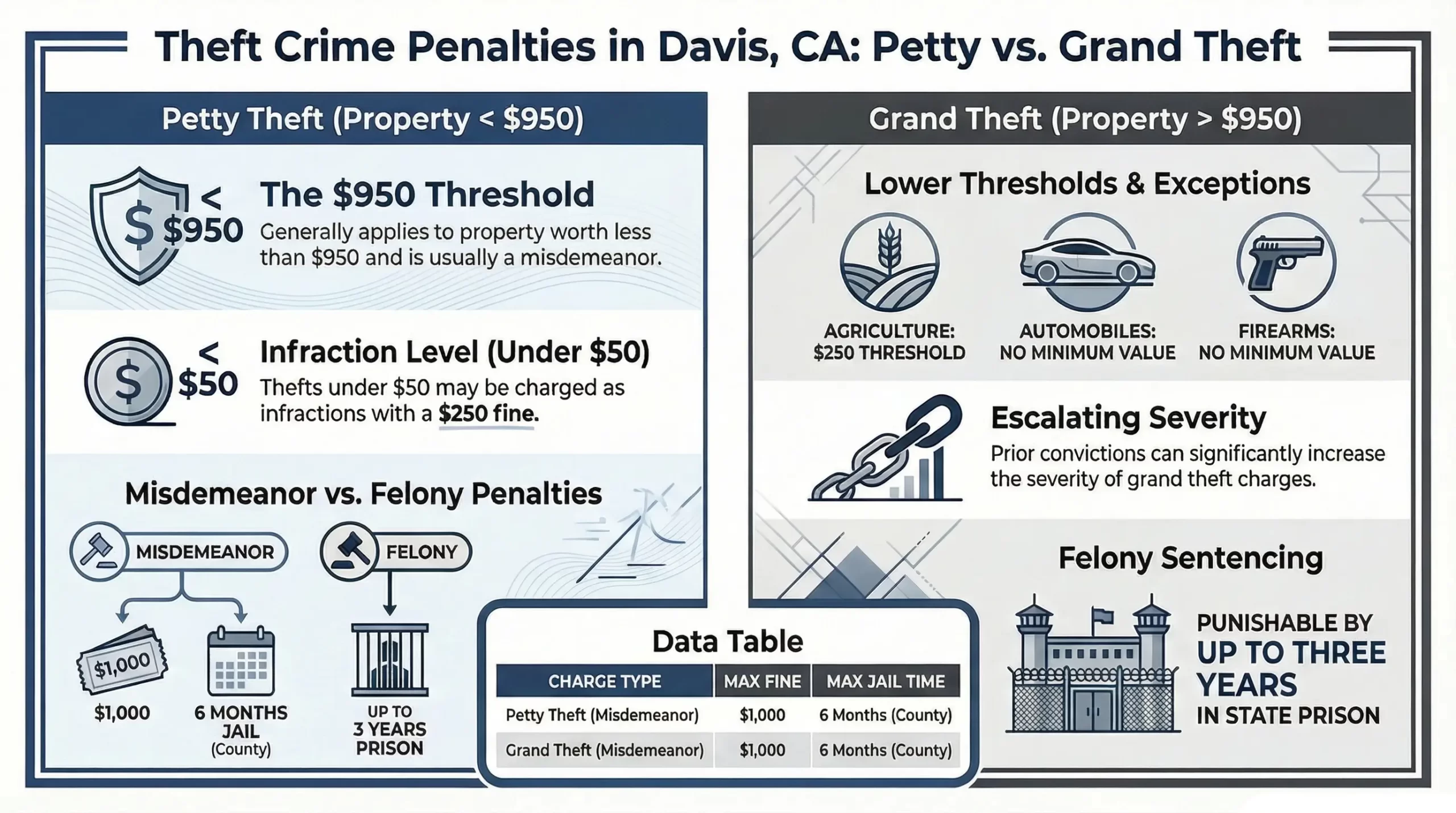
The penalties for theft crimes vary depending on the crime classification and whether there are any aggravating or mitigating factors. Petty theft is the theft of property worth less than $950; it’s usually a misdemeanor. Theft involving property worth less than $50 can be punished with a fine of up to $250 and may be charged as an infraction, a less serious offense than a misdemeanor.
Punishments for misdemeanor petty theft cannot exceed a $1,000 fine and/or six months in county jail. Punishment for felony petty theft may involve up to three years in state prison.
Grand theft typically involves property worth over $950. However, the minimum property value for grand theft is $250 for some agricultural products, and for automobiles and firearms, there is no minimum. As with petty theft, prior convictions may increase the severity of grand theft charges. The penalty for misdemeanor grand theft is up to a $1,000 fine and/or six months in jail; for felony grand theft, it’s up to three years in state prison.
Challenging Theft Allegations in Davis
Some common defense strategies against theft charges focus on the prosecutor’s obligation to prove the defendant’s intent to commit theft. If you’re facing theft charges and believe you have evidence to demonstrate a lack of intent, you should hire a theft lawyer to help you make your case.
For example, if someone takes a bag because they believe it belongs to them, that’s not in itself a crime. In this case, their documented ownership of a bag identical to the one they took would be compelling circumstantial evidence for their innocence.
Other arguments for a lack of intent might try to demonstrate that the defendant was forced to steal, that they had permission, or that they intended to return something borrowed. The burden of proof for intent is high and rests with the prosecution, so a strong challenge to a claim of criminal intent can be very effective.
FAQs
Can Smaller Thefts Add Up to Grand Theft in California?
Yes, in California, smaller thefts can add up to grand theft. If someone engages in multiple different acts of theft, the value of the property stolen in each act may be added together to surpass the $950 minimum property value for grand theft. This is true even if the property was stolen from different victims and/or in different counties.
What’s the Difference Between Carjacking and Grand Theft Auto in California?
In California, carjacking and grand theft auto are two separate offenses; carjacking involves stealing an automobile through the use or threat of force, while force is absent in auto theft. Carjacking is the more severe charge and can carry enhanced penalties. The California Highway Patrol reports that 176,230 vehicles were stolen statewide in 2024, a 13.14% decrease from 2023. Only 5.39% of thefts happened in Northern California, including Yolo County.
What Should I Do if I Am Charged With Theft in Davis, California?
If you’ve been charged with theft, get a criminal defense lawyer as soon as possible. A Davis theft attorney can offer you support from the moment of arrest; if police question you, you have the right to request a lawyer and remain silent. Gather any evidence demonstrating your innocence. Try to stay calm and remember that you are entitled by law to legal representation and a fair trial.
What Is the Statute of Limitations on a Theft Crime in California?
The statute of limitations on a theft crime in California depends on the severity of the theft charge. Prosecutors usually have a year from the date of the alleged offense to file a case for misdemeanor petty theft. The general 3-year statute of limitations for felonies applies to felony petty theft with a prior conviction and felony grand theft.
Schedule a Free Consultation With the Law Office of Conor Bell in Davis
At the Law Office of Conor Bell, we are here to help you defend yourself against theft charges and work toward the outcome that is most favorable in your case. For legal support in your theft case, contact our law firm to schedule a free consultation. Our office is based in Napa, and we serve clients in Lake Tahoe, Sacramento, and Davis.
© by Law Office of Conor Bell . All rights reserved. | Sitemap | Digital Marketing By: 
*Images are obtained under license from Canva and other third-party stock image providers, with attribution included where required.