Sacramento DUI Lawyer
Sacramento DUI Attorney
If you have been charged with DUI in Sacramento, it can be hard to navigate California’s complicated court system. If you are found guilty of DUI, you could face jail time, fines, license suspension, and even problems in your personal and professional life. It’s important to know California’s DUI laws, the penalties for breaking them, and your legal choices, hiring a skilled Sacramento DUI lawyer can help you.
The attorneys at the Law Office of Conor Bell know how hard it is to follow California’s DUI rules and how a conviction can affect every part of your life. Our DUI lawyers are dedicated to giving you a personalized legal experience that helps you face the lowest number of consequences possible. Our main goal is to make sure that each client’s defense is unique and fits the specifics of their case.

Understanding DUI Charges in Sacramento, California
California has strict DUI laws that are designed to penalize those who are guilty and to dissuade behaviors that put others at risk. It is illegal to drive a car while intoxicated by drugs, alcohol, or both. California’s laws follow strict Blood Alcohol Concentration (BAC) limits, including:
- 08% or higher for drivers over 21.
- 04% for commercial drivers.
- 01% for drivers under 21 under the state’s zero-tolerance policy.
Many people think that failing a sobriety test will lead to conviction on a DUI charge. But there are many factors that can be the biggest challenge in defending a DUI offense. Procedural errors or flawed testing methods are the main reasons.
Types of DUI offenses
- Misdemeanor DUI: Generally, the charge for first-time offenders where aggravating factors are absent.
- Felony DUI — This can be applied to cases that cause injury or death, or in cases with multiple prior convictions.
Legal Penalties for DUI in Sacramento
The penalties for a DUI conviction can vary depending on the circumstances of your case. Mitigating or aggravating factors that are present could significantly increase the penalties that you face. No matter what the circumstances of your case may be, it is important that you share all the details with your attorney to help build the right defense. Even if you violate the law, you are protected by attorney-client privilege, and honesty can significantly help your case.
The sentence for a DUI is mostly set by state law, but judges can use their own discretion, if necessary, based on the specifics of the case. If found guilty of DUI, you could face fines, jail time, probation, drinking education programs, and the revocation of your license. The severity of the penalties depends on several circumstances, including:
- Whether this is your first DUI or you have been convicted of DUI before in the last ten years
- The presence of aggravating factors such as driving too fast, driving with a child in the car, or causing an accident resulting in injury or death
- Whether there was an accident and it was caused by drugs, alcohol, or a mix of the two
Judges use a list of mitigating and aggravating factors to figure out the right sentence within the range that is allowed. For some accused of DUI, however, there is the opportunity to reach a plea deal with the prosecution that could reduce the penalties you could face and avoid sentencing in court.
The penalties for a DUI sentence are harsh and depend on how many times the person has been convicted before. This also depends on if there are any other factors that make the case worse.
Potential penalties for a DUI include:
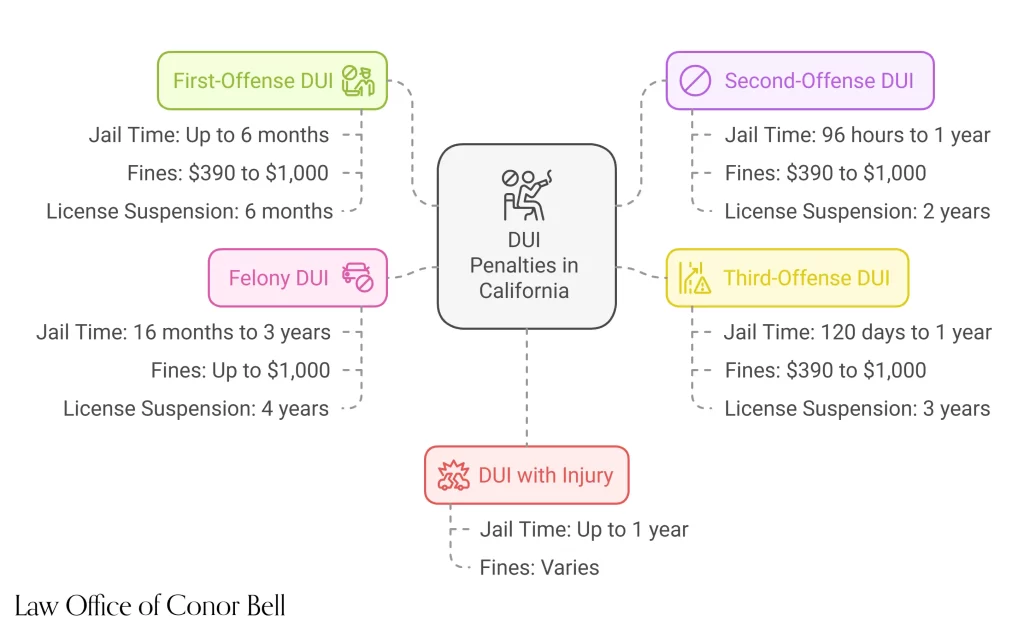
- First DUI charge. Up to six months in jail, $390 to $1,000 in fines, six months without a license
- Second DUI charge. 96 hours to one year in jail, $390 to $1,000 in fines, two years without a license
- Third DUI charge. 120 days to a year in jail, fines up to $5,000, three years without a license
These penalties apply to misdemeanor DUI charges. However, there are many circumstances that could change the potential penalties you could face. If you’ve been arrested for a second offense, an experienced second-offense DUI attorney can help you navigate the legal process and work toward the optimal outcome.
If you are also dealing with theft charges, a theft lawyer can help you understand your rights and explore the best defense strategies to minimize penalties.
California DUI Aggravating Factors
DUI charges could be accompanied by aggravating circumstances that could not only increase the potential penalties faced for a DUI charge but could cause additional charges to be applied. These are referred to as aggravating factors. When aggravating factors are present, judges are less likely to be lenient. Some common factors that make DUI cases worse in California include:
- Traveling with a small passenger. If you get a DUI and there is a child under 14 in the car, you may have to serve additional jail time. This time increases with each offense. For instance, if you serve an additional 48 hours for the first offense, you may have to serve an additional ten days if this happens again on a second offense.
- More than one victim in the car. If more than one person is hurt or killed in a felony DUI case, the term can be increased for each victim.
- Driving faster than the speed limit. If you were going significantly over the speed limit, this could also result in additional jail time.
- Driving through construction or safety zones. In California, DUI crimes in certain safety zones, like construction zones, earn additional fines, sometimes double the average amount.
These are just a few of the aggravating circumstances that could increase potential DUI penalties. Knowing all the circumstances of your arrest and what led to the arrest allows our team to build a defense that works for your case.
Felony DUI in California
In California, most DUIs are misdemeanors, but in some cases, a DUI charge can be classified as a felony. Felony DUIs have much harsher punishments, such as long-term license suspension, heavy fines, and time spent in jail or prison. Most of the time, a felony DUI charge comes from these three situations:
- Causing harm or death. If your DUI causes major harm or death to another person, you will likely be charged with a felony and face up to four years in prison and fines of $390 to $5,000. You could be charged with vehicle manslaughter or second-degree murder if the DUI kills someone.
- Any fourth DUI in ten years. In California, you can be charged with a crime if you are found guilty of a fourth DUI in ten years.
- Previous conviction for felony DUI. If you have been convicted of a felony DUI before, any later DUI offense will also be considered a felony, even if it does not involves injury or other factors that make the first offense worse.
You may have a harder time finding work, getting professional licenses, or finding a place to live after being convicted of a felony DUI. A skilled DUI lawyer can help you fight these charges to protect you from such consequences.
In 2023, Sacramento County reported over 450 people killed in alcohol-involved collisions. If you are facing assault charges, an experienced assault lawyer can also provide the strong defense you need, working tirelessly to protect your rights and to help you navigate the complexities of the legal system.
The Science Behind DUI Breath and Blood Testing
Chemical test results can be some of the most important evidence presented in a Sacramento DUI case, but a BAC number does not exist in a vacuum. Breath and blood testing depend on properly functioning equipment, correct testing procedures, and biological assumptions that may become relevant when evaluating the reliability of a particular result.
A Sacramento DUI lawyer can examine the testing process instead of just assuming that a reported BAC conclusively establishes what a driver’s blood alcohol concentration was at the time of driving, since there are a variety of factors that may impact the validity of a given test result.
How DUI Breath Testing Works in Sacramento
Currently, the Sacramento County District Attorney’s Crime Laboratory uses the Dräger Alcotest 9510 as the instrument for evidential breath alcohol testing. The device analyzes ethanol in exhaled breath using two pieces of technology: infrared spectroscopy and an electrochemical fuel cell. The crime laboratory is responsible for maintaining the county’s breath-testing program and training and certifying officers who administer tests.
California’s DUI law outlines the per se alcohol limits as 0.08 grams of alcohol per 210 liters of breath, corresponding to the commonly discussed 2,100-to-1 blood-to-breath relationship. Breath testing is intended to analyze deep-lung breath, but alcohol remaining in the mouth can potentially complicate a test.
Recent drinking, regurgitation, burping, or other circumstances may introduce alcohol into the mouth that does not accurately represent alcohol carried from the bloodstream into the lungs. As such, the specific circumstances surrounding a breath test are meaningful and may be used as part of a defense.
A DUI defense investigation may look at when the test took place, whether required procedures were followed, the testing instrument’s maintenance history, the driver’s medical history, and whether anything happened before or during testing that could affect the result.
Title 17 and California DUI Testing Procedures
California takes driver safety very seriously. In 2024, the California Highway Patrol collaborated with the California Office of Traffic Safety and launched a year-long campaign worth over $6 million, which focused on decreasing impaired driving incidents across the state. However, incidents do still regularly occur. Therefore, procedures must be in place for determining whether a driver ingested drugs or alcohol that may have negatively impacted their driving.
Forensic testing is a significant part of that process. California regulates forensic alcohol testing through Title 17 of the California Code of Regulations. These rules establish standards intended to help ensure that breath and blood samples are reliably collected and analyzed.
For breath testing, California regulations require continuous observation of the person for at least 15 minutes before the sample is collected. During that period, the person must not have ingested alcohol or other beverages, vomited, eaten, or smoked.
Blood collection is also subject to specific requirements. Among other safeguards, the skin usually cannot be cleaned with an alcohol-based substance before the sample is drawn. Proper collection, preservation, labeling, storage, and chain of custody are all important factors to consider when evaluating blood evidence.
A procedural problem does not necessarily cause DUI evidence to disappear automatically. However, departures from required testing protocols may provide grounds to question the accuracy, reliability, or evidentiary weight of a particular result.
Can Medical or Biological Conditions Affect a Breath Test?
Certain physiological circumstances can be relevant when evaluating breath-alcohol evidence. For example, gastroesophageal reflux disease (GERD) or even isolated acid reflux may raise questions about whether alcohol from the stomach entered the mouth before a breath sample. The significance depends on the circumstances, including whether reflux actually occurred during the relevant testing period.
Certain breath-testing technologies can flag substances other than beverage alcohol. Ketosis, which can occur during fasting and very low-carbohydrate diets or in people with diabetes, produces ketones including acetone, which can sometimes cause a false positive result. Whether this affects a particular evidential device requires examination of the instrument and testing circumstances.
Other, less common medical conditions may also impact test results. Auto-brewery syndrome is an extremely rare but documented condition in which microorganisms in the gastrointestinal tract produce ethanol internally, potentially leading to a positive result even when no alcohol has been consumed. A claimed medical explanation for a BAC result typically requires credible medical evidence instead of simple speculation.
Ultimately, chemical testing is scientific evidence, and such evidence should be appropriately and scientifically evaluated. Instrument records, testing procedures, timing, medical history, and other evidence may all be relevant when assessing the prosecution’s BAC evidence.
What Happens During the First 24 Hours After a Sacramento DUI Arrest?
The immediate aftermath following a DUI arrest can involve both the criminal case and a separate DMV administrative process. Understanding the difference is important because action in one proceeding does not automatically protect a driver’s rights in the other. A DUI arrest and its aftermath will typically proceed in the following order:
- Arrest and Chemical Testing. After a DUI arrest, an evidentiary chemical test is typically required. In an alcohol-only Sacramento DUI case, Sacramento Police Department policy provides a choice between a breath and blood test. Drug-only and drug-and-alcohol cases typically require blood testing. The driver could be booked into the Sacramento County Main Jail or processed and released in accordance with applicable procedures.
- Driver’s License Confiscation and Pink DS 367 Issuance. For qualifying adult DUI arrests, Sacramento officers complete a DS 367, formally known as the Aged 21 and Older Officer’s Statement. Sacramento PD policy directs officers to seize a California driver’s license and give the driver the pink driver’s copy of the DS 367. The pink document serves as both a notice of the DMV action and a temporary driver’s license.
- 10-Day DMV Deadline Begins. Generally, a driver only has ten days after receiving a suspension or revocation order to request an Administrative Per Se hearing. Missing that deadline can mean losing the opportunity to challenge the administrative suspension through the ordinary hearing process.
- Driver Contacts the Correct Sacramento DMV Office. The Sacramento Driver Safety Office is located at 4700 Broadway, 2nd Floor, Sacramento, California, 95820.
- Preparation for Criminal Defense. After an arrest, it is critical to collect supporting evidence. The driver should start preserving information that could become relevant to the criminal case, including receipts, photographs, video, witness information, medical information, and details about what they ate or drank and when.
License Suspensions and License Limits
If you are found guilty of DUI in California, you will automatically lose your license. However, a lot of drivers can get limited licenses that let them drive to important places like work or school while their license is suspended. Many times, drivers with these limited licenses must have an Ignition Interlock Device (IID) installed on their car which will test their BAC to ensure that it is below the legal limit before the car will start.
The amount of time you may be required to have the IID on your car will depend on the factors surrounding your DUI and whether it is your first, second, third, or subsequent DUI violation.
The Implied Consent Law in California
California’s implied consent rule says that all drivers must take breath, blood, or urine tests if they are legally arrested for DUI. If you refuse to take these tests, your license could be taken away automatically for one to three years, based on your driving record.
Defense Strategies for DUI Cases
While the circumstances of each DUI charge are unique, there are some common defense strategies that an attorney may use to help challenge the circumstances of the charge to have your charges reduced, dropped, or reach an acquittal. Common defense strategies include:
- Unlawful police stop. Reviewing the police stop is one way that your lawyer may challenge the charges against you. Police must have a valid reason to pull you over for the initial stop. This could include speeding, improperly changing lanes, or another type of moving violation. Once the stop is made, if the police suspect that you are under the influence, they can proceed with DUI protocols. However, if the initial stop was not legal, the DUI charge is not admissible.
- Challenging the chemical test. Police may use a breathalyzer, a blood test, or both to test your BAC. Both tests, however, could have significant flaws in their testing and results. A breathalyzer may be improperly calibrated, or the officer may not have the right training to administer the test. A blood test could be completed in a contaminated facility or improperly handled in the chain of custody. Either test could return false results that could cast doubt on the charges you face.
- Suppressing evidence through legal motion. Submitting a motion in which you wish to suppress evidence is an attempt to prevent certain evidence from being presented in your case. This could stem from other areas of the case that are challenged. If, for example, a police officer did not have grounds to pull you over, their dash cam video may then be inadmissible as evidence.
These are just a few of the defenses that your attorney could use to defend you against DUI charges. There are, of course, many other types of defenses that could be used. Discussing your case with your attorney can help to devise the right plan that could work in your case.
Steps to Take if Charged With a DUI in Sacramento: Hire a DUI Lawyer
If you are arrested for DUI in Sacramento, remain calm and apply these important steps. Cooperating with law enforcement during the arrest is important so that you do not have additional charges filed against you. You should, however, avoid answering any questions about your drug or alcohol intake without a lawyer present. This is why it is important to hire a DUI lawyer who can listen to your side of the story and prepare accordingly.
Keep your matter under discussion only with your attorney. Collect any data or witness information that will support your defense. Be sure to follow any court instructions about license suspensions or hearings. Ultimately, follow the advice and guidance of your attorney. With their help, you can avoid unintentionally incriminating yourself and ensure your case remains on the facts.
FAQs
How Much Does a DUI Lawyer Cost in California?
The cost of a DUI lawyer in California varies based on the complexity of the case and the attorney’s experience. Fees will generally be lower for misdemeanors and higher for felonies, particularly those involving accidents, injuries, or multiple other charges. Additional expenses such as court fees or professional witness costs may also apply.
Should I Hire a Lawyer for a DUI in California?
If you are charged with a DUI in California, you should hire a lawyer even though it is not required. DUI laws are complicated, and a skilled lawyer can help you navigate the court system, make plea deals, and maybe even get your charges or penalties reduced, dropped, or bring an acquittal. A lawyer will protect your rights and improve your legal chances. Discussing the circumstances of your case with your attorney will help them devise a defense plan that works for your case.
How Much Is a DUI in Sacramento?
The cost of a DUI in Sacramento depends heavily on the details surrounding the DUI. Factors contributing to the cost include fines, court fees, DUI education programs, increased insurance rates, and potential costs of ignition interlock devices. First-time offenders generally face smaller fines than those who have subsequent offenses and those who have aggravating factors.
What Is the Three-Hour Rule for DUI in California?
The three-hour rule in California states that a BAC test must be completed within three hours of the initial stop by police. If the test is conducted outside of those three hours, it may not be accurate in reflecting the BAC at the time of driving. If you feel your test was inaccurately taken, be sure to discuss that with your attorney, who can use that to challenge the validity of the results.
Will I have to go to court?
Yes, you need to go to court. If you are charged with DUI, you have to be present throughout the legal process, including an arraignment, pre-trial hearings, and a trial, if your case goes that far. It is always advisable to hire a knowledgeable DUI attorney for the DUI case court procedures to ensure that your rights are protected and that you can present your case properly in court.
Contact Our Sacramento DUI Lawyers Team Today
If you are facing a DUI charge, an attorney at the Law Office of Conor Bell can help. We keep up with the newest DUI rules and improvements in chemical testing technology to build a defense that works. Our lawyers carefully look over every part of your case to make sure that your rights are protected and that you have the greatest defense possible.
We defend your rights and provide you with a tailor-made defense to strive for the greatest possible outcome. Acting as quickly as possible following a DUI arrest can give the defense more time to preserve evidence, address the DMV proceedings, and prepare for the criminal case. Contact us today to get started.
Sacramento DUI Resource Links
- Is Your License Suspended Immediately After a DUI in California?
- What Is the Best Case Scenario for a First-Time DUI in California?
- Can You Get a Commercial License with a DUI in California?
- What Is the Minimum Sentence for a DUI in California?
- What Happens If You Get a DUI in California?
- What Is the Most Common Sentence for a DUI in California?
- How Long Does a DUI Stay on Your Record in California?
- Can a DUI Be Dismissed in California?
- How Long Do You Have to Wait to Get an Expungement in California?
© by Law Office of Conor Bell . All rights reserved. | Sitemap | Digital Marketing By: 
*Images are obtained under license from Canva and other third-party stock image providers, with attribution included where required.